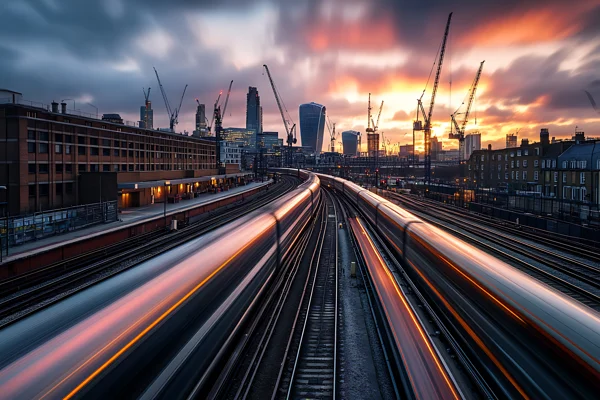
Top table dinner: integrating track and train – a relentless focus on the customer – top ten takeaways
The latest in the series of top table dinners jointly hosted by Stephenson Harwood LLP and AtkinsRéalis was held on Wednesday 18 November 2026. We were privileged to be joined by Richard George, Chair of Network Rail, who shared his views on the vision for GBR and the critical steps required to deliver a truly customer-focused railway, with a particular emphasis on the importance of successfully bringing track and train together under the new regulatory framework.
Guests were challenged to consider how GBR can deliver lasting positive change for rail customers, while navigating the complexities of culture, funding, and local decision-making. To those who joined us, thank you for your contributions and engagement. We hope you found the evening valuable. For those unable to attend, we share below the top ten takeaways from the evening, capturing the key themes discussed.
1. Here and Now: High costs, balancing revenue and social benefit
The high cost of running Britain’s railway compared to European counterparts is thought to be partly due to inefficiencies in operations and staffing. It is also driven by procurement processes and political priorities, which the room considered thought makes enduring relationships and the sharing of ideas difficult. Lengthy procurement processes and substantial bid costs pose significant challenges for suppliers and only drive up overall costs. An example was given of recent rolling stock orders taking substantially longer and costing substantially more when undertaken by the public sector. GBR must balance revenue generation with its social mandate, ensuring that cost reductions do not compromise safety, accessibility, or the public good. GBR also needs to recognise that the increasing focus on social value also drives up cost, and a balancing exercise is needed to drive real value. Alternative procurement models, such as Early Contractor Involvement which is used by Transport for London, or international examples of reimbursing a portion of bid costs for unsuccessful bidders, can encourage innovation and reduce risk. It was widely accepted that the previous attempt of the Department for Transport (DfT) on “market-led proposals” was not good. Removing red tape from the industry was generally acknowledged to be positive, although it was noted that politicians operate on shorter term election cycles and the railway often needs to take a longer term view.
2. Better Best Forgotten: Learning from the past
The origins of the current rail reform programme go back to the high profile timetable problems in May 2018. A root cause of the difficulties was that people could foresee them but those people were not empowered to make changes. The creation of GBR is intended to modify the decision-making profile and processes and empower the new organisation to deliver change for the benefit of the end user. Historically, competition between operators for revenue allocation, and individual operator-centric approaches to capacity and service proposition, were thought to create barriers to adopting a network-wide holistic approach to the railway. GBR will change that. Sharing learning was a theme which emerged on many tables – both learning from the past to form a GBR that works for existing and potential customers, and ongoing continuous learning and improvement.
3. 5, 6, 7, 8: Taking steps now to deliver for the future
The formation of GBR is a pivotal step towards ending the longstanding fragmentation between track and train. The industry is already moving towards the more integrated railway envisioned in the Railways Bill currently completing its Parliamentary journey. Integrated businesses are being created, with train operations and infrastructure management coming under one management team. Joint decision-making under a unified regulatory framework was considered to be critical for delivering a seamless experience to rail customers. Attendees thought the integration process must be carefully managed to ensure that the needs of both passenger and freight customers are prioritised, and that the industry does not revert to siloed thinking. Examples were given of joint initiatives which are already driving change. The Long Term Rolling Stock strategy (LTRS) was one example – for the first time in 30 years a coherent strategy for the industry has been published. The Waterloo East-Charing Cross 22-day blockade over the summer was another, where integration and the removal of tensions between revenue compensation and engineering work meant 30% project savings could be delivered. Lessons can no doubt be learned from that blockade, and an important cultural element for GBR will be to share learnings and drive continuous improvement.
4. One Touch: Keeping politics at arm’s length
Maintaining an arm’s length relationship between GBR and government is considered essential to protect GBR from political interference and ensure a relentless focus on the customer. There should just be one point of control for the industry and that should be GBR. The railway is highly political, and there is room for politicians and stakeholders to have their say at the strategic level, but when it comes to delivery that needs to be GBR alone. A comparison was drawn with the NHS, where political decision-makers have strategic influence but day-to-day medical decisions are left with the experts: the doctors and nurses throughout the NHS. There are concerns about DfT overreach and the risk of GBR falling back into old patterns of bureaucracy. There should be no over-reliance on the right people being in post at the right time and, to the extent possible, GBR needs to be immune from shifts in personnel and political priorities. The longevity of GBR depends on setting up organisations with well-defined principles and values from the outset. The influence of His Majesty’s Treasury must not be underestimated either. Thoughts from within the room included getting rid of the annual business planning processes (which were instead pejoratively described as annual cost cutting processes), ensuring HMT knows that it will have to invest upfront for reform to be successful, and that HMT will have to recognise that procuring rolling stock through competed franchises is not the only way to ensure value for money is delivered. The room had some hope that the new Chair of GBR, with an HMT background, may be able to find ways through for the benefit of the industry and the customer. Structures which worked in the 1990s, or even since the pandemic, may not be suitable for today’s challenges. There is a risk that individual units within GBR could compete with each other, undermining the overall culture and success of the organisation.
5. Happy: Measures of success
It was almost universally agreed that the two key measures of success for GBR will be safety and customer satisfaction. Beyond those key metrics, financial efficiency, reducing overall subsidy, and delivering value for money for the taxpayer will be priorities. This includes revenue growth and effective use of railway assets. Learning lessons from the privatised railway, and ensuring the spirit of innovation continues, will deliver success. Chiltern Railways was given as an example of private sector success: Marylebone was set for closure in the 1980s, and in the 1990s a long term contract was awarded which incentivised investment in the railway which has transformed the operation. Equally, LNER was championed as an example of public sector operators delivering growth and efficiency if the right culture is fostered. In moving forward, the importance of microcultures needs to form an important part of GBR’s decision-making: what works in London may not work in Liverpool or Llandudno. It was hoped having regional business units within GBR will support a focus on local needs. There is now the best data which has ever been available from the Rail Customer Experience Survey about how the railway is performing, and in future this will be available daily throughout GBR to allow a relentless focus on the passenger. The power of people coming together, having a vision, and being focussed on delivering for the customer were accomplishments which must continue to be encouraged in the GBR world.
6. Take Me for a Ride: Need for a deliverable LTRS, not just a wish list
There was a diverse range of divided opinions from across the room about the recently-published LTRS. It was acknowledged that the LTRS represents the first comprehensive national approach to the procurement and delivery of rolling stock and rail infrastructure. It offers a vision to the industry about what GBR’s aspirations are and how they might be delivered. Whilst the LTRS aims to address the fragmented nature of the rail industry with a clear roadmap for rolling stock and infrastructure investment, questions remain about whether the current proposals are truly strategic or simply aspirational. Concerns were raised by some attendees about the need for funding certainty for the LTRS, and whether GBR will genuinely have the expertise to implement such an ambitious plan. The LTRS’s effectiveness will ultimately depend on transparency, robust funding mechanisms, and the ability to manage whole life costs across projects. Costs of rolling stock were highlighted in the room – the LTRS noting that rolling stock costs in Great Britain were typically 20% higher than in Europe, which was linked with the varieties of rolling stock operate on our railway network being far more numerous. More generally across the supply chain, greater certainty and visibility in the future pipeline of rail projects was thought to be needed to support all levels of the supply chain, from tier 1 suppliers to niche subcontractors. Funding certainty is also critical, as framework agreements often fail to provide the pipeline of work suppliers need to invest in skills, personnel and products. This may mean their expertise is lost to other industries. With GBR becoming a bigger buyer, the supply chain is keen to have opportunities to continue to participate and encouraged GBR to fully engage with the supply chain and take a balanced approach to national and local procurement.
7. Say You’ll Be Mine: Winning public trust through communication
Building a positive public perception and reputation in the media is essential for GBR’s success, especially with the upcoming general election in 2028. Recent media scrutiny on the declining performance of certain operators following renationalisation has shown that there was some way to go to win hearts and minds. Greater control over messaging to passengers, with clear communication and transparency, is needed to ensure GBR is seen as a modern, customer-focused, organisation. At the same time, a degree of caution was offered about re-announcing existing initiatives or taking credit for what the private sector had done. People should be treated as being intelligent and can often see through those types of announcement. It is not just about marketing, and examples were given about how the railway – and GBR – can embed itself in local communities. Viewing stations as community assets, not just property, and planning for major events like the upcoming Euros in 2028 can encourage rail use and drive growth.
8. It’s the Way You make Me Feel: The power of positive partnerships
Partnerships with Mayoral Strategic Authorities (MSAs) and local governments are necessary to serve customers and secure investment. New customers bring new revenue to the railways, and focusing on local areas and leveraging land use and bus routes may be avenues to drive further growth. There is still uncertainty about whether MSAs should procure services directly, given their role in funding, and how GBR can best support local needs while maintaining national standards. Decentralising decision-making and integrating businesses under GBR will empower local teams to respond more effectively to customer needs. The evolution of devolution, including partnerships with MSAs, is a key opportunity for GBR to unlock investment and tailor services to local communities. It is important to understand the unique powers and influences in different cities, and to balance GBR’s role with that of local authorities, especially when funding comes from multiple sources.
9. Last Thing on My Mind?: Freight, open access and capacity planning
Ensuring the success of freight in the new GBR framework is a priority, supported by national freight targets that provide leverage for securing government funding. Alongside that, the benefits that competition on the railway in the form of open access has brought in terms of driving quality and revenue was recognised. There were a mix of views in the room, from “open access is dead” through to open access being an important part of future healthy competition and allowing league tables and comparisons to be drawn. At the heart of both freight and open access businesses is the ongoing ability to gain access to the network, and there was some nervousness around the room about whether capacity will be managed and allocated in the right way by GBR. On the other hand, there was a view that GBR should be trusted to allocate network resources transparently and efficiently. This could involve an uphill battle in the first few years – and legal disputes were likely – to establish credibility. Clear planning, stakeholder engagement and communication would help drive success across the industry.
10. What the Future Holds: Cultures coming together
In Network Rail and nationalised passenger operation coming together, there will be a combination of two very different cultures. At its most simplified, Network Rail delivers projects and is motivated to keep costs down, whereas operators are motivated to deliver revenue whilst keeping costs efficient. Within both organisations, there will be local microcultures, and there is considerable value in those. It was acknowledged that there was a challenge to ensure a customer-centric culture reaches those on the ground, whether responsible for track or train. GBR will need to capture all of the positive cultural elements, and promote those, sharing learning as it does. Senior leaders are committed to ensuring that GBR is not a “Network Rail 2.0” as that would be a failure: the integration of track and training is about aligning decisions holistically and not always allowing one perspective to predominate. What must predominate, however, is a safety culture and GBR will need to clearly demonstrate it is competent to safely manage all of the parts of the railway it is responsible for.
Share Article
Related Expertise


Related Articles
Licence to run: unpacking the draft Great British Railways licence
CMA’s new consumer protection powers: 10 questions every rail business should be asking

Visibility is not bankability: what does GBR’s Rolling Stock and Infrastructure Strategy mean for financiers?